
The Story: When Sunrise Doesn’t Cooperate
Some mornings just don’t give you anything.
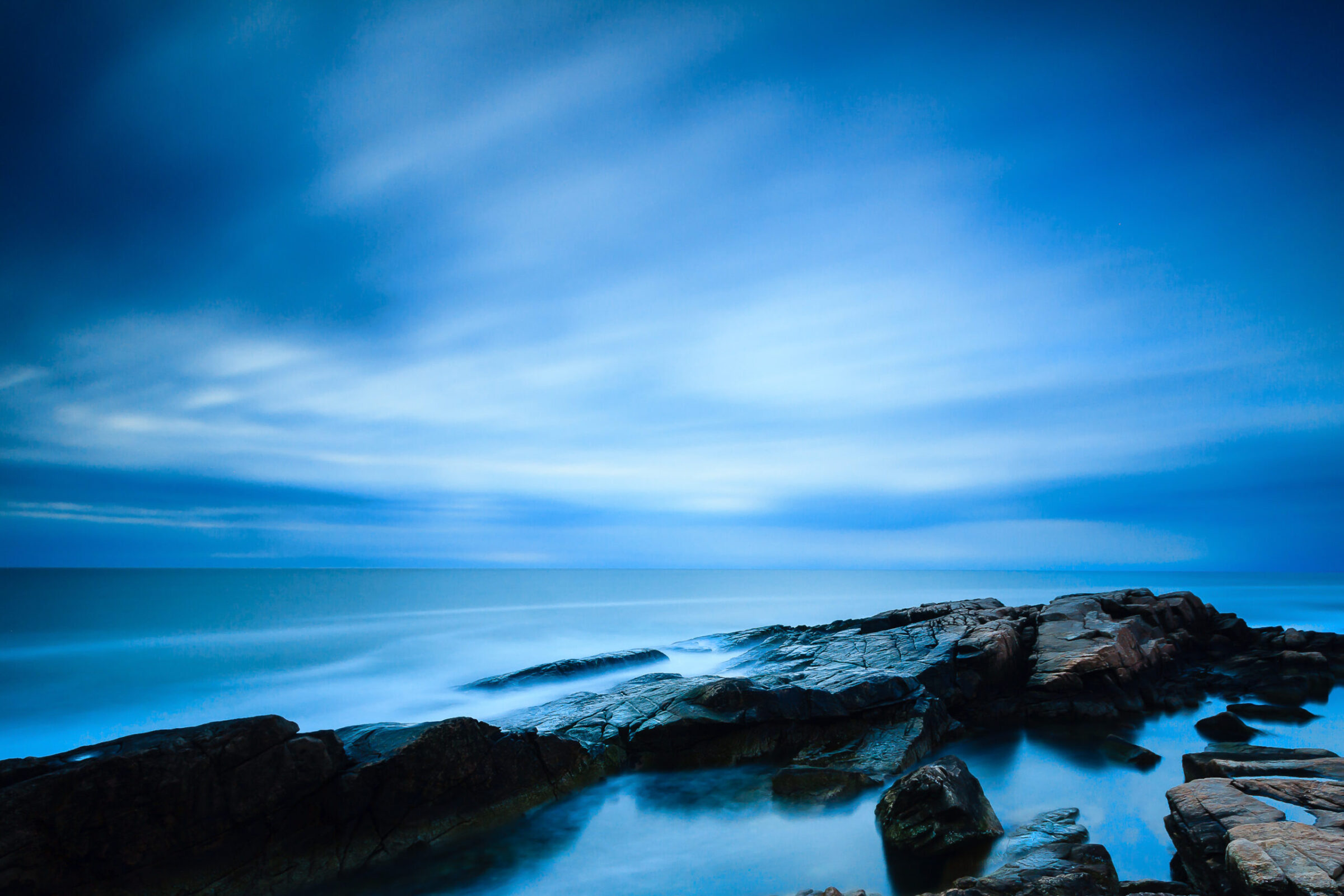
On this particular sunrise at the Newton Avenue Rocks in Narragansett, Rhode Island, I wasn’t feeling it. I had positioned myself right at the tide line, working the movement of water over the rocks, hoping the sea would give me something dramatic.
It didn’t.
The sky was flat. The colors were muted. The waves lacked rhythm. Every frame felt lifeless. Sunrise had beaten me.
I packed up, already replaying the morning in my head as a loss, and began climbing the rocks toward the bluff. No image. No story. Just damp boots and a bruised ego.
But just before reaching the top, I turned around.
And there it was.
The same rocky coastline that had frustrated me minutes earlier now felt alive. The clouds I’d dismissed as dull were stretching and twisting with subtle motion. The scene hadn’t changed dramatically.
I had.
There’s a moment in photography when something clicks—not technically, but emotionally. You feel it before you fully understand it.
This was that moment.
Changing the Approach
I unpacked my gear again.
Tripod down. Camera mounted. This time, I reached for my 10-stop neutral density filter.
Normally along the Narragansett coastline, I experiment with shutter speeds between 1/4 second and 15 seconds to shape the water’s movement. But this morning called for something different.
If the waves wouldn’t perform, maybe the sky would.
I committed to long exposures lasting several minutes.
And that’s when the scene began to transform.
After a few attempts, I found that a two-minute exposure gave the clouds just enough motion — not chaos, not blur, but intention. The sky developed a slow, sweeping energy that balanced the stillness of the rocks below.
For the first time that morning, I felt it.
Excitement.
The kind that makes you glance at the back of your camera and whisper, “There it is.”
Embracing the Unexpected
The long exposure introduced a strong blue color cast from the neutral density filter.
Normally, I would correct it. Neutralize it. Bring everything back to “accurate.”
But this time, I paused.
The cool tone added mood. It felt honest. It reflected the way the morning had felt — quiet, restrained, a little heavy, but beautiful in its own way.
So I left it.
Sometimes perfection is less interesting than personality.
The Lesson: Don’t Leave Too Soon
Every time I head out with my camera, I hope to learn something.
Sometimes it’s technical — refining shutter speeds or composition.
Sometimes it’s about light and weather.
And sometimes it’s about patience.
This morning at Newton Avenue reminded me of something simple but powerful:
Don’t leave too soon.
The scene you’re frustrated with might just need a different perspective.
The sky you’ve written off might be waiting for a longer exposure.
The story might not reveal itself until you’re halfway back to the car.
Creativity rarely rewards impatience.
Stay a little longer.
Turn around one more time.
Experiment when the obvious approach fails.
You might just catch the one that almost got away.
Technical Details
Location: Newton Avenue Rocks, Narragansett, Rhode Island
Camera / Lens: [Insert gear]
Filter: 10-stop neutral density
Shutter Speed: 2 minutes
Aperture: [Insert]
ISO: [Insert]
Approach: Shifted from short wave-focused exposures to multi-minute long exposure to introduce motion in the clouds and create mood across the sky.
Tip: When a composition feels flat, don’t abandon it immediately. Change one variable — perspective, focal length, or shutter speed — before you walk away.
Practice This Yourself
Try this exercise:
- Visit a familiar coastal location at sunrise
- If the scene feels dull, change your approach before leaving
- Experiment with longer exposures to introduce sky movement
- Allow color shifts to guide mood rather than automatically correcting them
Sometimes the best images come after the moment you almost quit.
Continue the Coastal Series
This photograph is part of my Rhode Island Seascapes collection, exploring the evolving mood of the Narragansett coastline.
If this story resonates, explore other Behind the Photograph features or visit the Seascape gallery to see how patience and perspective shape each image.
Bring Beauty Into Your Spaces
From printer to wall—farm to table for your soul.