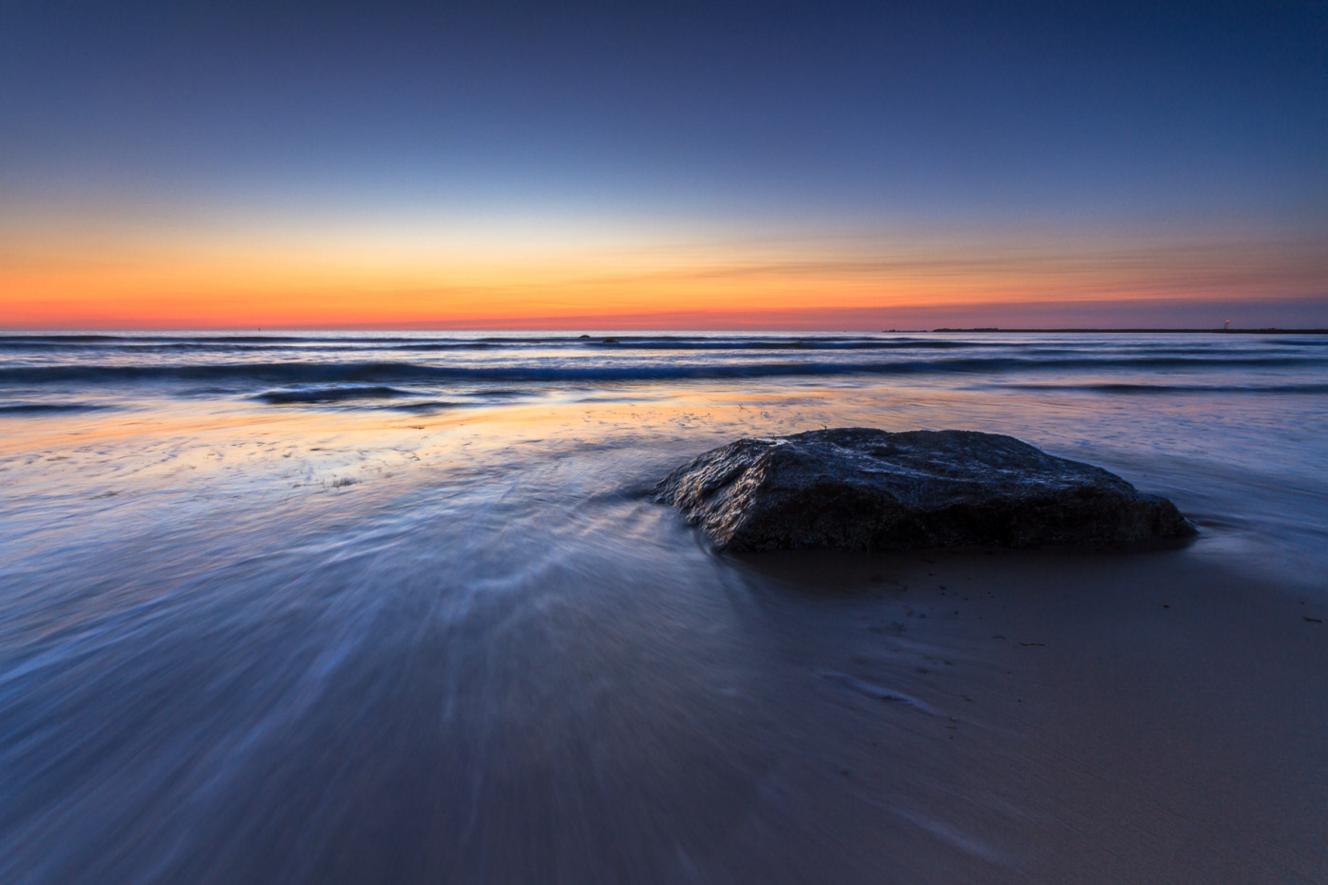
One year for my birthday, my wife Roni and I spent the weekend on Block Island — that quiet, windswept gem off the southern coast of Rhode Island. Our son was working there for the summer during college, and it seemed like the perfect excuse to see him, explore the island, and maybe sneak in a little photography (OK, maybe a lot of photography). On our first afternoon, I spotted a rocky little beach across from our hotel. It had potential — the kind of potential that gets a photographer’s gears turning. So I set my alarm for the ungodly hour of 4 a.m. and headed out alone for a peaceful walk along the shore, scouting for just the right spot. I found it. A rock. Nothing fancy. Just a rock perfectly placed to anchor a photograph. I set up the tripod, cranked up some tunes, and waited for Mother Nature to paint the sky. I stood there in the salty stillness, just soaking it all in — one of those mornings where you don’t just see the beauty, you feel it. I consider myself lucky to have witnessed it. As a photographer, one of the most common questions I get is:
“What settings did you use?” It’s a good question — but it’s not the right question. The better question is: “What did you feel when you took this photo?” That question gets to the heart of it. The craftsman in me knows how to use the camera. I adjust aperture, shutter speed, and ISO to gather the right amount of light — just like filling a glass with water. Too little and the image is dark and dry. Too much and the details overflow and disappear. You want just enough light to quench the soul. But here’s the secret sauce: There are endless combinations of settings that give you the same exposure. What changes is not how much light you record — it’s how you render the scene. That’s where the artist steps in.
Take this photo, for example. I shot it at ISO 100, f/8, and 1.3 seconds. But I could’ve taken the exact same exposure at ISO 1600, f/5.6, and 1/25 second. Both would record the same amount of light… but the feeling would be completely different. A faster shutter speed would have frozen the waves — sharp, energetic, full of motion and drama. But that’s not what I felt that morning. I felt peace. Stillness. The gentle hush of the tide whispering against the shore. So I chose a slower shutter speed to blur the water and let it flow like a lullaby.
I use the word “relatively” for a reason. Shutter speed is always relative to what’s moving — a wave doesn’t move like a motorcycle, and a crashing tide isn’t the same as a trickle at low tide. Understanding that difference is how you shape emotion in your work. That’s why chasing the exact settings from someone else’s photo doesn’t usually work. Light shifts. Tides change. But if you understand what the camera is doing — if you’ve trained the craftsman inside you — then you can let the artist lead. You can choose the settings that reflect not just what you see, but what you feel.
And that morning, standing barefoot on a quiet beach while the world slept — I felt calm. I felt gratitude. I felt a little magic. So I slowed the shutter, quieted the world, and let that feeling spill gently into the frame.
The camera can be taught. The feeling behind the photo can’t. Learning to ask what you feel, not just what to set, is what actually moves a photographer forward.
This dawn at Block Island is proof that the right exposure isn’t a formula — it’s a decision made with feeling. If that kind of thoughtful, unhurried image belongs on your wall, it’s available as a print.