
Question 9 of 18 · Chapter 2: Choosing

How to Pick a Print Size That Fits Your Wall
Can’t decide what size print to put on your wall? You’re not alone. It’s one of the most common questions I get. The right size makes a room look balanced, and the wrong one bugs you every time you walk past it.
So I put this guide together. It covers sizes for the living room, bedroom, hallway and office, with examples from real rooms and a couple of easy ways to test a size before you order.
Click a question below to jump to the answer:
- What size print should I buy?
- What’s the difference between a statement piece and an accent print?
- What size works best in my room?
- How do I tell if a print is too big or too small?
Statement Piece vs Accent Print
Start by asking what job the print has. Is it the main thing people look at in the room? Or a piece that complements what’s already there? That leads us to two helpful categories:
Statement pieces are the dominant artwork in a room — they catch your eye first and help define the space.
Accent prints complement other elements without overpowering.
Recommended Sizes by Room
Here are size ranges that work well in the most common rooms:
| Room | Statement Size | Accent Size |
| Living Room | 30″ × 40″ – 40″ × 60″ | 18″ × 24″, 16″ × 20″ |
| Dining Room | 30″ × 40″ | 16″ × 20″, 18″ × 24″ |
| Kitchen | 24″ × 36″ | 12″ × 18″, 16″ × 20″ |
| Bedroom | 24″ × 36″ – 30″ × 40″ | 16″ × 20″, 12″ × 18″ |
| Bathroom | 16″ × 24″ | 11″ × 14″ |
These sizes fill the wall without leaving it empty or cramped.
👉 A quick rule of thumb for statement pieces: aim for about 60–75% of the width of the furniture or wall where it lives.

Mike’s Take on Size
I tend to believe that bigger is better.
One of the reasons I love metal prints is that they don’t need a mat or a frame to feel complete. The image stands on its own. It owns the wall.
A traditional frame contains an image, which is why a lot of people prefer paper fine art prints for classic spaces.
A metal print floating off the wall does something different. It expands into the space. It becomes part of the room rather than something simply hanging on it.
A large metal print doesn’t whisper. It arrives. Like a diva. And honestly? Sometimes a room needs that kind of presence.
A glimpse of my solo gallery exhibit, featuring 16×20 inch fine art prints.
How Do I Tell If a Print Is Too Big or Too Small?
This is where most people hesitate. Here’s an easy way to judge:
- Too Small: It looks like a “postage stamp” on the wall or feels like it’s floating alone.
- Too Big: It overwhelms other elements, crowds furniture, or makes the room feel off-balance.
Pro tip:<\/strong> Cut out kraft paper, or tape up some good old blue painter’s tape to outline the print right on your wall, and just let it live there for a bit. An hour, a day, a week, whatever it takes. Your eye will tell you more than any ruler, and you’ll know it when you know it.
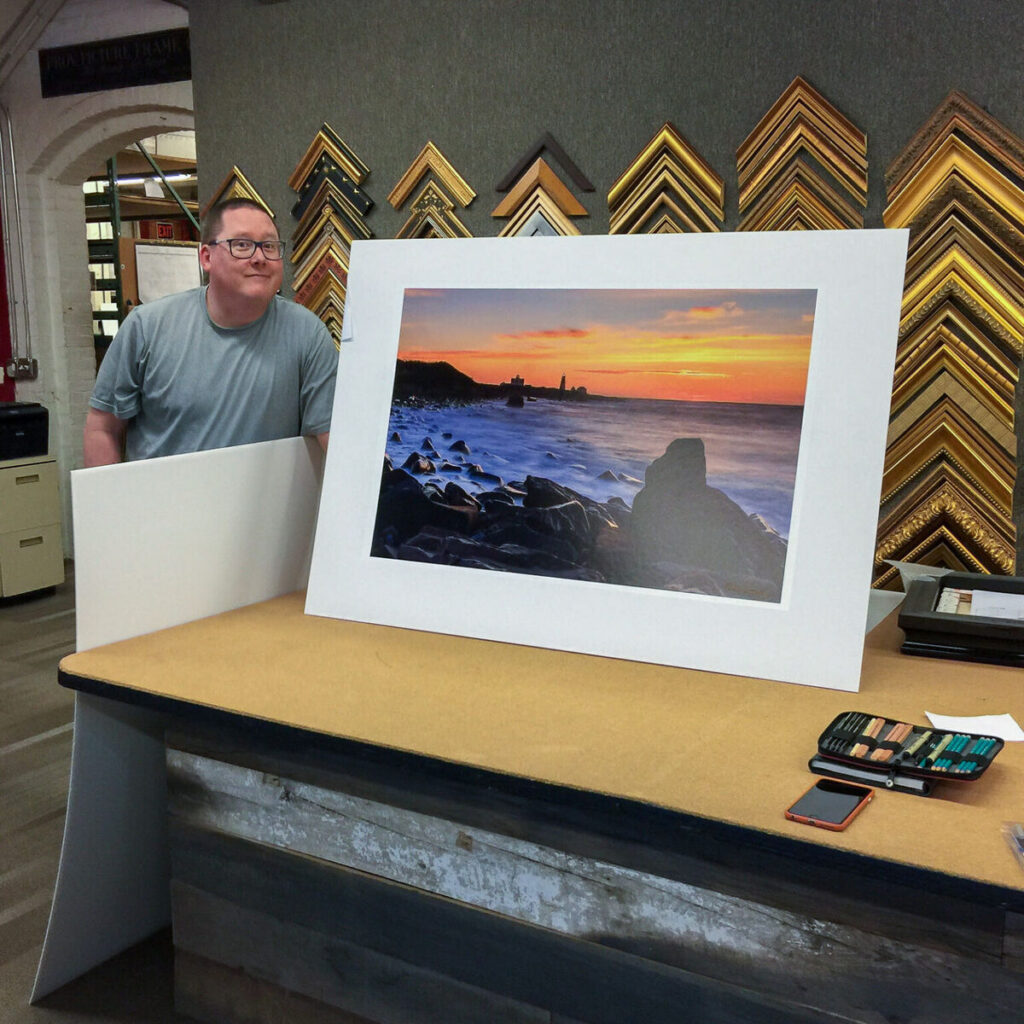
Sharing a moment with one of my prints at Providence Picture Frame.

Do I Need Matting or Framing?
Matting and framing do a job. They protect your print and make it look finished.
Matting gives your artwork breathing room and a classic look. Framing protects edges and helps the print last longer.
If you’d like professional matting and framing, my friends at Providence Picture Frame have decades of experience (over 100 years!) making art look good and last.
I love a classic framed print. A clean white mat, with a simple black frame. To me it just looks right. I have a mix of both metal and paper prints in a traditional black frame.
Putting the final touches on a print with the team before it heads to its new home.